


close
Choose Your Site
Global
Social Media
Views: 0 Author: Site Editor Publish Time: 2026-10-15 Origin: Site


Orbital welding mechanizes a circular weld path, commonly using TIG. Precision applications include clean process tubing, aerospace fluid lines, industrial alloy piping, and heat-exchanger joints. Open heads serve suitable fusion or wire-fed procedures, while enclosed heads are often used for thin-wall clean tubing. Each application requires its own tooling and acceptance plan.
The word “precision” is useful only when tied to an observable requirement. A process-tube weld may need a controlled internal profile and limited oxidation. An alloy pipe joint may need the specified penetration and deposited weld geometry. An aerospace fluid line may place particular importance on dimensions, joint integrity, and traceability. Those requirements can overlap, but they are not interchangeable.
An orbital system controls the path and coordinates selected welding parameters. It reduces variation caused by manual travel and repeated torch handling. However, dimensional consistency in motion does not prove metallurgical quality or system cleanliness. The equipment must operate inside a process that controls preparation, materials, shielding, and examination.
A controller can call up the same program twice while the physical joints differ. One component may have a slightly different wall, another may have a contaminated edge, and a third may be warmer from an earlier operation. These differences explain why high-precision welding requires defined incoming-part conditions and process checks alongside program management.
For an Open-head Orbital Welding Machine, the control boundary should be explicit. Current, rotation, gas timing, wire feed, and cooling may be coordinated, depending on the configuration. Arc-length control and oscillation are additional functions that must be confirmed, not inferred from the presence of a touchscreen or a programmable power source.
A machine-generated parameter suggestion is a starting point for development. It does not establish a qualified procedure for every alloy, fitting, or service condition. The responsible process team must evaluate the result against the project's actual acceptance criteria.
High-precision industries use orbital welding for different reasons. Some prioritize clean internal surfaces, others repeatable welding in difficult positions, and others coordinated filler deposition. Selecting one architecture for every precision sector risks choosing equipment that solves the wrong problem.
Industry or application | Precision concern | Selection implication |
|---|---|---|
Semiconductor gas and process tubing | Internal condition and contamination control | Evaluate enclosed fusion arrangements and root shielding for suitable joints. |
Pharmaceutical processing | Cleanable weld profiles and documented acceptance | Define internal examination and process records. |
Aerospace fluid systems | Joint integrity, material control, and geometry | Validate the specific tube or fitting configuration. |
Chemical and energy piping | Alloy-specific integrity and repeatable deposited passes | Assess an open head with the required wire and motion controls. |
Heat-exchanger fabrication | Repeated joints across a tubesheet | Use dedicated tube-to-tubesheet tooling. |
Thin-wall stainless process tubing that can be welded autogenously is often a candidate for enclosed fusion heads. An open head may be useful where geometry, filler requirements, or another process constraint calls for it, but “high precision” alone is not a reason to select the open architecture.
Internal backing-gas requirements remain separate from external shielding. A head's shielding arrangement protects the outer weld zone; the tube interior needs its own protection when the procedure specifies it. The required purge condition and examination of the internal surface should be part of the application trial.
When a joint needs filler metal and several passes, an open orbital welding system can coordinate travel with deposition. The benefit is controlled repetition of the intended process around a fixed pipe. Material-specific heat requirements, interpass conditions, and inspection still govern the work.
Specialized sectors can impose demanding approval requirements, but equipment selection should avoid unsupported claims of automatic compliance. A general-purpose orbital system should not be assumed acceptable for aerospace or nuclear production without the required application review, qualification, and project approvals.
The strongest reason to consider an open head is a process requirement that the proposed configuration can demonstrably satisfy. That may include wire feeding, accessible torch adjustment, suitable multi-pass operation, or additional motion control. Its nominal diameter range is only one part of that assessment.
Open heads expose the welding region to the surrounding environment. Local shielding must remain effective in the actual workplace, including drafts and changing assembly orientation. Operator visibility can help process observation, but it also requires suitable arc protection. The accessible design is a functional trade-off, not a universal advantage.
Measure the space needed for the head to mount, the torch to travel, and any wire mechanism to remain correctly positioned. Check valves, elbows, supports, and nearby parallel pipework. A head that clears a straight demonstration tube may encounter interference on the real assembly.
For multi-pass work, consider each required electrode position and any motion added between passes. Access should be checked throughout the planned process, not just at the root pass. Cable and hose routing must also remain suitable through the travel sequence.
Open-head orbital equipment should be compared with the actual available production routes. An assembly that can rotate may suit a positioner-based welding station. An installed fixed pipe may favor orbital travel. Some small batches may remain practical through manual welding with appropriate controls. The suitable route follows production conditions rather than the automation label.
A useful feasibility trial uses the real material, preparation, fitting geometry, and inspection plan. Assess mounting time, accepted weld quality, repeated-cycle stability, and changeover effort. A trial that proves only that the electrode rotates is insufficient for a high-precision purchasing decision.
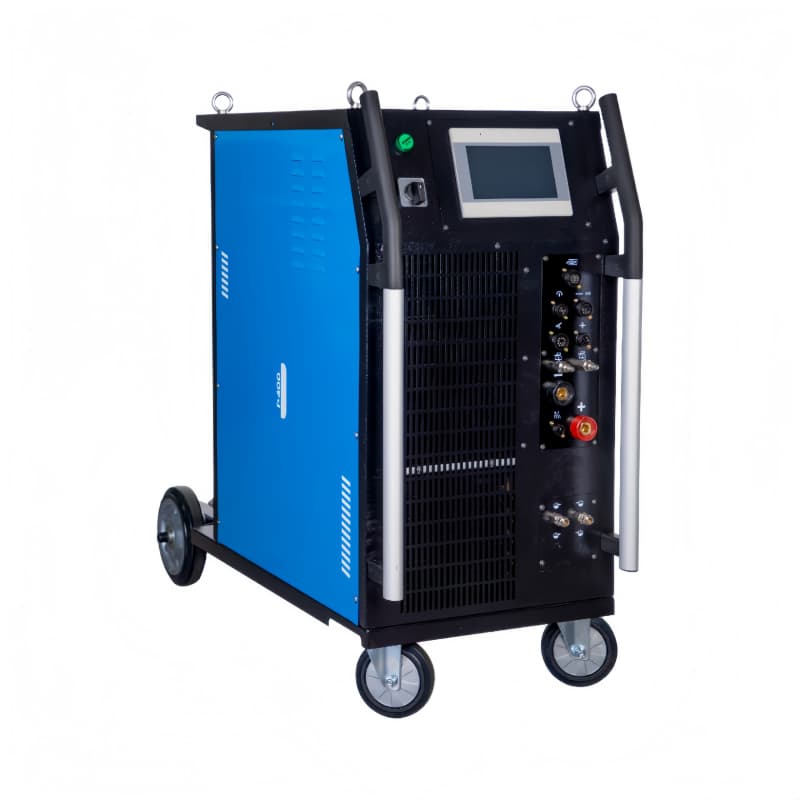
The head moves and positions the welding tool; the power source supplies and coordinates essential functions. An Open-head Orbital Welding Machine needs compatible electrical, motion, gas, cooling, and wire interfaces for the proposed procedure. A current rating by itself does not confirm complete system compatibility.
The AW400 Programmable Welding Power Source has a welding-current range of 5–400 A, a 7-inch touchscreen, and controls covering gas, current, rotation, cooling, and wire feeding. It is a power-source and control component; the compatible welding head and configured functions determine which joints the complete system can perform.
For a precision project, those functions should be assessed as part of the proposed system. Verify the supported head, available adjustment ranges, operating ratings, and required accessories. Avoid assuming that every optional control or data function is included in every supplied configuration.
Current and travel speed jointly influence the weld's thermal conditions. Pulsing changes how energy is delivered over time. Electrode distance affects arc behavior, while wire position and feed influence deposition. Changing one variable can alter the useful range of another, which is why a validated schedule is more than a collection of independent settings.
For example, increasing travel without reviewing deposition can change the amount of metal added per unit length. A different arc distance can alter the weld even when current remains unchanged. These relationships explain why development should use a controlled trial process and examination, rather than isolated adjustments based on external appearance.
Power-source ratings, head cooling, cables, and workpiece temperature all matter during repeated welding. A higher maximum current does not necessarily increase accepted production output. The joint may be limited by preparation, cooling intervals, purge requirements, or the allowed thermal conditions between passes.
Specify the planned workload and workplace conditions when assessing equipment. Demonstrate repeated cycles representative of production, including required pauses and checks. This establishes a more useful operating picture than a single maximum-output demonstration.
High-precision production benefits from a clear connection between the physical weld and the process used to make it. Assign joint identifiers and connect them to material information, the approved procedure, program revision, operator, and examination result. The record should allow the quality team to identify affected joints when a process issue appears.
Program storage is not the same as a complete audit trail. A controller may retain settings while other records must be maintained separately. If digital records are required, establish what the supplied equipment actually captures, how records are exported, and how they connect to the production identification system.
Specify who may create, edit, approve, and release weld programs. A renamed file is not sufficient revision control. The approved schedule should remain identifiable, and a change should have a documented reason and any required validation before use on production joints.
Physical changes also require attention. A different electrode setup, head, tooling arrangement, material, or preparation condition may affect the process even when the program name remains unchanged. The quality plan should define which changes require checking or requalification.
The examination method should follow the joint and service requirements. External visual checks, internal viewing, dimensional checks, leak testing, and other examinations answer different questions. A process log does not replace a required test, and a leak test alone does not establish every structural or metallurgical requirement.
Acceptance concern | Production control to establish |
|---|---|
Wrong material or preparation | Incoming identification and documented joint checks |
Unauthorized program change | Revision control and release responsibility |
Loss of shielding or interrupted cycle | Defined hold, investigation, and examination procedure |
Untraceable completed joints | Joint map and linked production records |
Unrepresentative equipment trial | Samples matching real geometry and acceptance criteria |
Before requesting a quotation, provide representative drawings, alloys, diameter and wall ranges, preparation, filler requirements, clearance restrictions, production rhythm, utilities, and record expectations. This lets a proposed open-head orbital system be judged against the complete task. It also identifies missing preparation or inspection resources before equipment arrives.
High-precision orbital welding depends on defining the required result and controlling the conditions that produce it. An Open-head Orbital Welding Machine is useful when its accessible tooling and configured process functions suit the joint, particularly where filler delivery or multiple passes are required. Wuxi Bohan Automation Technology Co., Ltd. manufactures automated welding equipment and provides the AW400 programmable power source. Assess the compatible head, process controls, repeated workload, and acceptance records together. The purchasing objective is a validated production method that consistently yields acceptable joints, with traceability appropriate to the application.
No. Confirm the feeder, wire capacity, delivery arrangement, and controller compatibility in the actual supply scope. An open frame alone does not establish wire-fed capability.
It should be treated as a development starting point. Required validation, procedure qualification, and release must be completed before production use on the applicable joints.
No. It is a programmable welding power source. Application capability depends on the compatible head, tooling, and other configured equipment supplied with it.
List the required fields, export format, joint identification, retention needs, and access controls. Demonstrate the actual record workflow with the proposed configuration.
Only within the applicable procedure and validation limits. Geometry changes can alter access, heat flow, and fit-up; review them before grouping fittings under one production program.


